10th April 2025 - A day to remember
Every photographer has their great days and stinkers. These are the days you will vividly remember for years to come, both good and bad. The good ones are where everything seems to go right or go above and beyond expectations. I could pick out a few days that go into this category off the top of my head over the years as they don’t come around that often. Today I will be discussing what I think is the one that beats them all at the top of the pedestal for one particular moment I had the opportunity to photograph but other parts of the day were a nice bonus on top. This day was 10th April 2025 which is now officially one year ago as of writing this post, time slow down!
It was coming to the end of a beautiful spell of weather in Ireland. Since late March, there had been plentiful sunshine. But nature still had a few more glory days in store to give us breaking records for sunshine. The full moon was also coming up with a few days that would be favourable to capture the moon setting to the west in a beautiful way. Every month around the full moon, there tends to be one or a few days where the light lines up to capture the moonset or moonrise without the need to bracket and photoshop to get an even exposure between the bright lunar disc and the landscape. This varies from month to month. Early to mid-spring tend to have multiple opportunities for moonset where this light is available and August/September tend to have multiple opportunities for moonrises where the same applies.
Why do I mention all of the above? On the morning of April 10th, the moonset was going to give a rare stunning alignment over the Dublin City skyline that could be photographed along the Great South Wall. The wall would be the perfect spot to mount the camera to get the distance required to magnify the moon against the city skyline. There was a challenge here because the sunrise wasn’t until 06:33 and the moonset itself when it goes below the horizon was 05:58 so there was a 35 minute difference and you also got to factor in the additional time to have the moon at an altitude needed to get it above the skyline so another 15-20 minutes at least. This meant light was at a premium and if you know anything about shooting the moon in low light, it tends to catch earthshine making it practically impossible to photograph in one single shot with a landscape. One thing that can ease this challenge is the presence of mist to mute how bright the earthshine is, similar to how haze and mist make the sun more orange/red. The same physics apply to the moon. It just so happens that the morning of April 10th was also a misty one with fog inland. This sounds too good to be true. How does one behold this much luck? Well look at the aurora displays in May and October 2024, even in Ireland you can gamble crazy luck like this.
The below was the plan from The Photographer’s Ephemeris app to align the moonset with the Samuel Beckett Bridge from the Great South Wall. We needed to mount up the tripods near the Half Moon swimming club on the Great South Wall. Needed to be there at least half an hour minimum to get prepared. It’s around 15 minutes to walk down at decent pace but you need to watch your step or you could trip very easily or even worse fall into the water.
Screenshot of the plan to align the moonset with the Samuel Beckett Bridge from the Half Moon swimming club on the Great South Wall on 10th April 2025 using The Photographer’s Ephemeris app. This app has a €10 one time purchase fee. Other similar apps include PhotoPills and PlanIt Pro.
Arrived at the scene. It was dark. The ISO would need to be set high. If you set too slow of a shutter speed, you will inevitably get blurry images from either camera shake because the zoom lens is big and bulky that even a slight breeze will move it at a micro level which is important when the field of view is heavily compressed as any movement will be exaggerated, or the moon moving. Remember that every second the moon is moving so your shutter speed needs to be set accordingly to get it sharp to avoid this blur depending on how far you’re zoomed in.
Waited for the moon to get more into position setting lower in the sky. As you can see from the different images, the moon got hazier and more muted as it descended through the sky. It was a red disc when it hit the Samuel Beckett Bridge. The inland mist did its job very well by muting the earthshine despite how dark it still was. If anything, it did its job TOO well because the moon became very hazy with not much structure to photograph losing detail of its craters. It can’t all be perfect, not to mention there was a ferry departing Dublin Port which nearly completely blocked our view of the moon! What we witnessed was wonderful enough and a moment not to forget. It was honestly up with the October 2024 aurora and June 2025 noctilucent cloud displays for the most beautiful things I’ve seen nature produce. I wish I had a better tripod which wasn’t strong enough to withstand the camera shake from the heavy lens and the little bit of breeze there was but you have to make do with what you have at a given time.
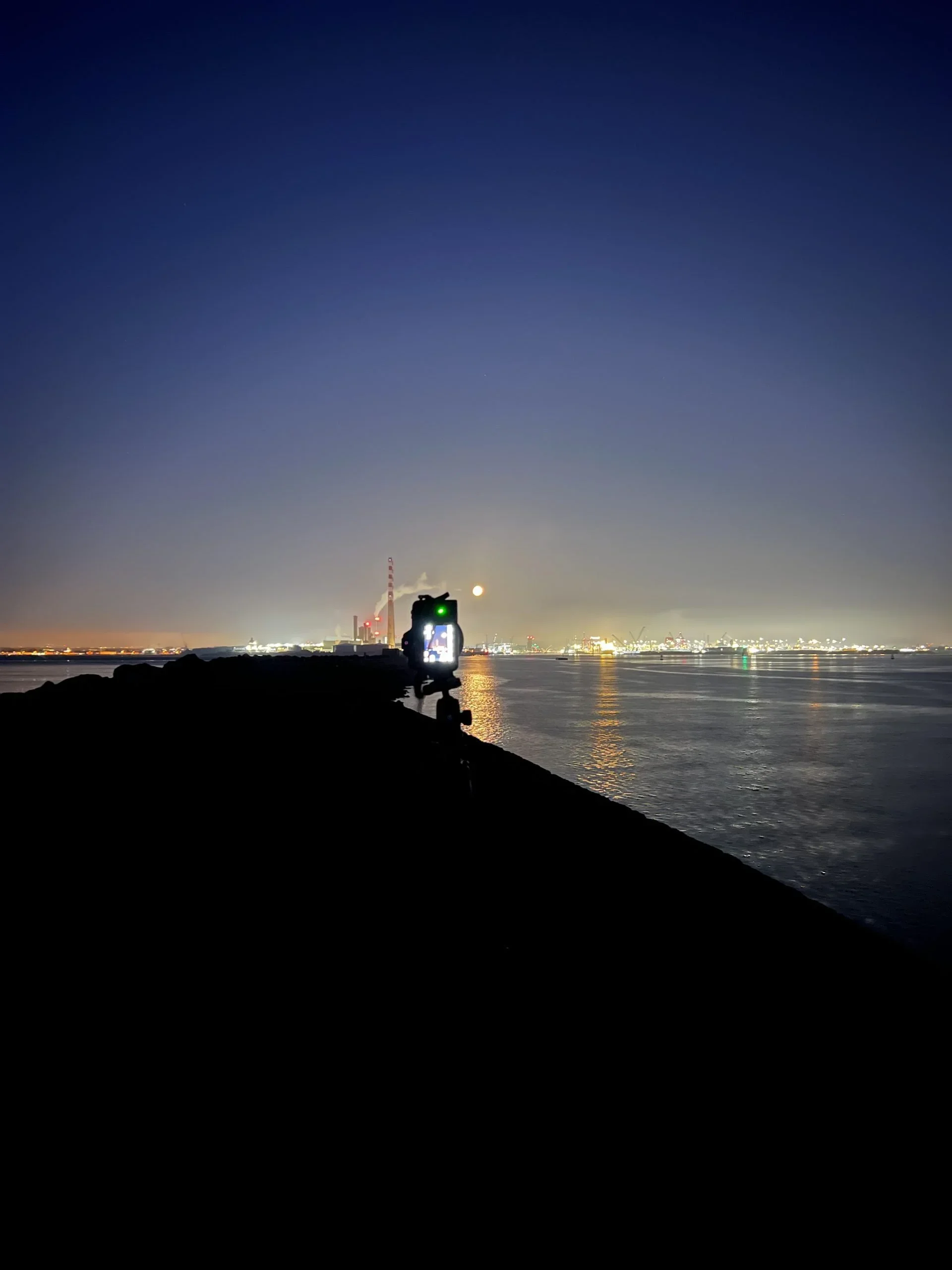
My camera capturing the moonset live at the Great South Wall. Note how small the moon is in frame when you’re not zoomed all the way in! You can just about pick up the Capital Dock building with the red glowing lights at the top in the distance - this building is zoomed in on the next pic below. You can also spot the fog and mist near the horizon versus higher in the sky which is clear.
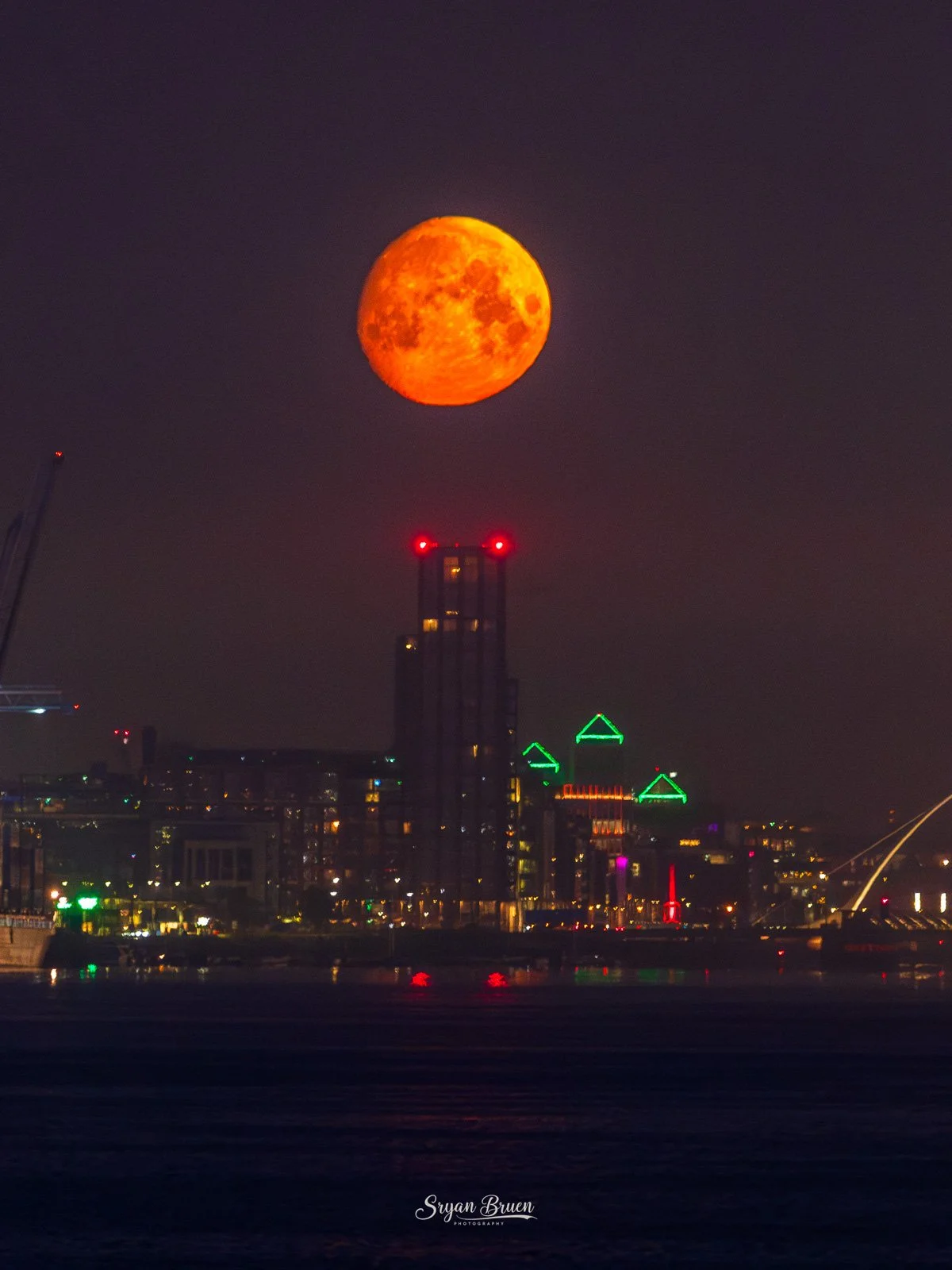
Moonset over Capital Dock. Captured with a Nikon D7500 using a Sigma 150-600mm Contemporary lens and the following settings ISO-2000, 1/15th of a second, f/5.6 @ 290mm.
The spectacular moonset in all its glory above the Dublin City skyline. We feared the ferry on the right would completely block our view of it but it added to the picture if anything. Captured on a Nikon D7500 with a Sigma 150-600mm Contemporary lens and the following settings ISO-12800, 1/15th of a second, f/5.6 @ 310mm. Yes you read that right.. ISO-12,800! Don’t be afraid to bump up the ISO, it may have given way to a noisy picture but it was sharp.
Moonset above the Samuel Beckett Bridge. Captured with a Nikon D7500 using a Sigma 150-600mm Contemporary lens and the following settings ISO-2000, 1/20th of a second, f/6.0 @ 500mm.
Moon setting over the Samuel Beckett Bridge - note the moon starting to lose detail of its craters as it gets fainter descending into the mist. Captured with a Nikon D7500 and a Sigma 150-600mm Contemporary lens with the following settings ISO-3200, 1/20th of a second, f/5.6 @ 340mm.
Then behind us at the same place, there was going to be a great sunrise which was going to align with North Bull Lighthouse. We had around 20 minutes to get back to the car park where the alignment would be. Got back with plenty of time to spare and get ready for another epic moment. The horizon was full of haze particulates, ideal for this kind of shot. It went exactly as planned with a big red sun and spectacularly there was a mirage too of the sun as it rose over the horizon right behind the lighthouse. That’s not something you could plan for and is purely luck of the draw. Could not believe the luck.
Red sun rising beside North Bull Lighthouse. Captured with a Nikon D7500 using a Sigma 150-600mm Contemporary lens @ 600mm with the following settings ISO-360, 1/1000th of a second, f/6.3.
Hazy red sunrise mirage aligned with North Bull Lighthouse from the start of the Great South Wall. Captured using a Nikon D7500 with a Sigma 150-600mm Contemporary lens and the following settings ISO-200, 1/1600th of a second, f/6.3 @ 600mm.
Sunrise aligned with North Bull Lighthouse. Captured with Nikon D7500 and a Sigma 150-600mm Contemporary lens @ 600mm using the following settings ISO-200, 1/2000th of a second, f/6.3.
Of course I couldn’t resist sending the drone up to get some shots of Poolbeg Lighthouse as well with the sunrise :-) Note the mist surrounding Howth in the distance.
Sunrise beside Poolbeg Lighthouse on the right side and Howth in the distance. Captured with DJI Air 3S at the following settings ISO-200, 1/2000th of a second, f/1.8 @ 24mm.
Sunrise beside Poolbeg Lighthouse on the right side. Captured with DJI Air 3S at the following settings ISO-200, 1/4000th of a second, f/1.8 @ 24mm.
Sunrise beside Poolbeg Lighthouse on the left side. Captured with DJI Air 3S at the following settings ISO-200, 1/2000th of a second, f/1.8 @ 24mm.
Another one of sunrise beside Poolbeg Lighthouse on the right side. Captured with DJI Air 3S at the following settings ISO-200, 1/2500th of a second, f/2.8 @ 70mm.
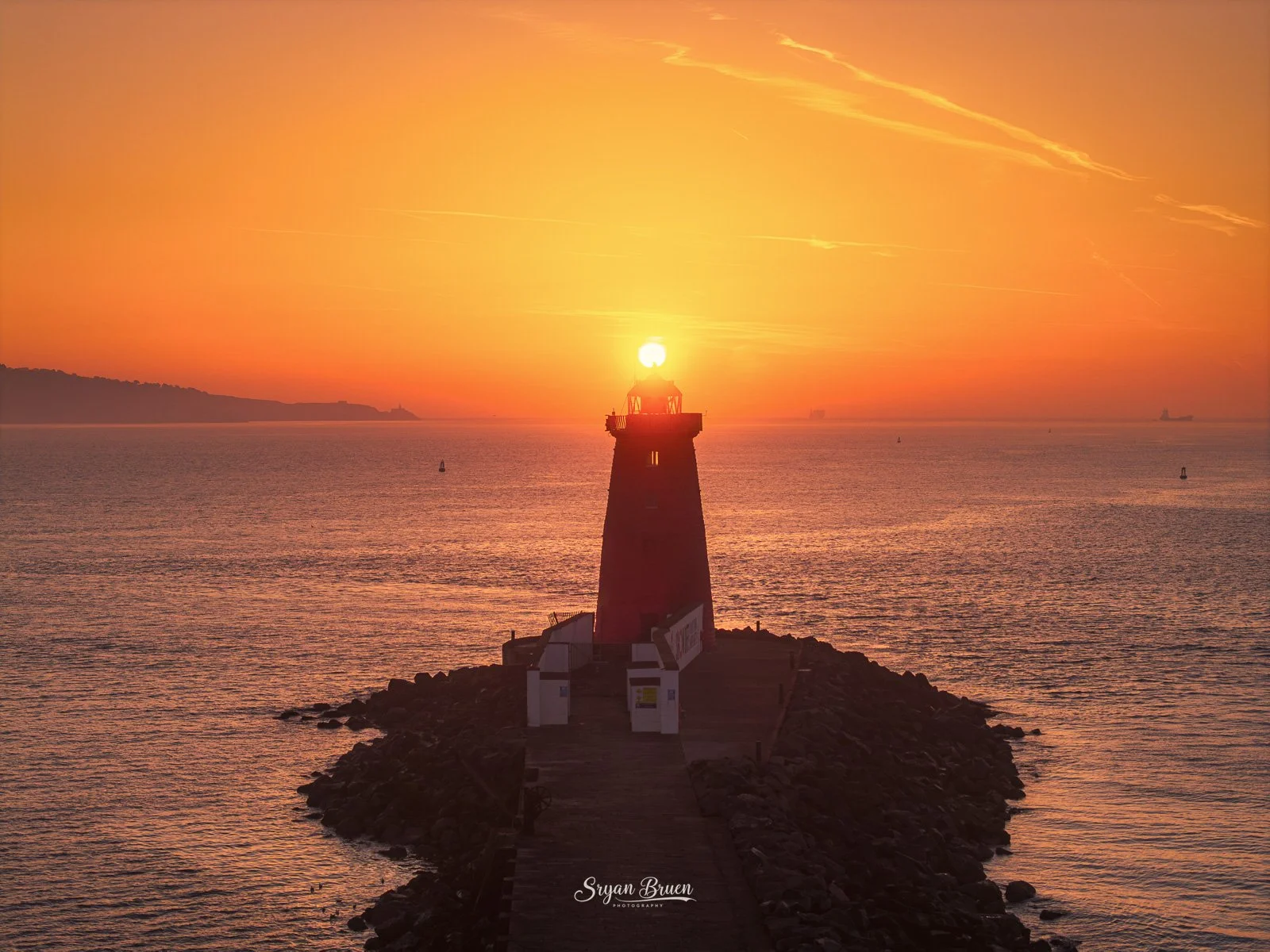
Sunrise over Poolbeg Lighthouse. Captured using DJI Air 3S and the following settings ISO-100, 1/1500th of a second, f/2.8 @ 70mm.
After such a magnificent morning at the Great South Wall, I was over the moon (ha) and went home but stopped off at Clontarf on the way. There was mist all over Bull Island. The light was harsh and golden hour had passed but I could not pass by without capturing the mist. So I seen trees on the golf course which were a perfect composition to catch with the mist. Just another moment for the books.
Misty Bull Island trees after sunrise. Captured with DJI Air 3S using the following settings ISO-100, 1/8000th of a second, f/2.8 @ 70mm.
Misty Bull Island trees after sunrise. Captured with DJI Air 3S using the following settings ISO-100, 1/8000th of a second, f/1.8 @ 24mm.
Wide angle of a misty Bull Island tree. Captured using DJI Air 3S and the following settings ISO-100, 1/8000th of a second, f/1.8 @ 24mm.
Mist rising from Bull Island. Captured with DJI Air 3S using the following settings ISO-100, 1/8000th of a second, f/2.8 @ 70mm.
Misty Royal Dublin Golf Course with Our Lady Star of the Sea and Poolbeg Lighthouse in the background. Captured with DJI Air 3S and the following settings ISO-100, 1/800th of a second, f/2.8 @ 70mm.
I had a good few hours to take in what I had captured that morning. It was something else, especially the moonset. Then later I decided to venture up to Carlingford Lough for the first time as it was a stunning day that could not be wasted. I first visited the Flagstaff Viewpoint - a place I had been meaning to check out. Instantly I seen why it’s a beloved spot, the views of Carlingford Lough are unreal. After that, went down to see Haulbowline Lighthouse for the first time as well. A lighthouse that I still need to return to get the moon and sun aligned with - don’t worry Ann Bruen if you’re reading this, it’s on the list to getting sometime in future!
Flagstaff Viewpoint looking down towards Carlingford Lough. Captured using Nikon D7500 with 18-55mm f3.5-5.6 lens and the following settings ISO-100, 1/250th of a second, f/8.0 @ 18mm.
Lonely tree at the Flagstaff Viewpoint. Captured using Nikon D7500 with 18-55mm f3.5-5.6 lens and the following settings ISO-200, 1/500th of a second, f/11 @ 18mm.
Haulbowline Lighthouse with the sunset in the background. Captured using DJI Air 3S @ 24mm with the following settings ISO-100, 1/8000th of a second, f/1.8. Probably could have used a ND filter to make the sky pop more as this was with my fastest possible shutter speed.
Sunset from Greenore. Captured with DJI Air 3S using the following settings ISO-100, 1/8000th of a second, f/1.8 @ 24mm.
I really enjoyed my time at the lough but thought it was time to go home until I looked at the sunset sky and said hmm, that looks promising for a colourful sky thereafter. After I came down the R173, it clicked with me that this would be a great time to return to the Fairy Tree in Knockbridge which was only half an hour away. I had previously been there to photograph an aurora with it in September 2024 and what a place. Lonely trees are always great subjects for photos. I’m glad I decided on this as I got a stunning sunset with it including a sun pillar and would be the final thing I’d capture on this long beautiful April day. There was light winds throughout and warm enough as well making it very pleasant.
Need not I remind that this was all in a SINGLE day…
Sunset at the Fairy Tree, Knockbridge with a sun pillar visible. Captured using a Nikon D7500 with an 18-55mm f3.5-5.6 lens and the following settings ISO-100, 1/500th of a second, f/8.0 @ 18mm.
Couldn’t not get a picture of myself with that sunset sun pillar and the Fairy Tree! Captured on DJI Air 3S using the following settings ISO-100, 1/350th of a second, f/2.8 @ 70mm.
Colourful sunset afterglow sky with the Fairy Tree, Knockbridge and a sun pillar as well. Captured with DJI Air 3S @ 70mm using the settings ISO-100, 1/40th of a second, f/2.8.
